
Why Your Architect Will Underbid Your Rammed Earth Project
In India, the phone call about rammed earth comes from an architect, in most cases if not always—not form a builder or a civil engineer. An architect who has seen the material, studied the possibilities, and who wants to use it on a project.
This is a good thing. Architects bring genuine curiosity about material performance. They ask questions about thermal mass, about surface texture, about what the wall can do aesthetically and environmentally. They see rammed earth as a design opportunity, not just a construction method.
And Indian architects bring something else that matters: a structural engineer. Unlike most civil engineers who handle their own structural work, architects in India typically engage a dedicated structural engineer for design. This means load paths get calculated. Wall thicknesses get specified. Openings get engineered. The structural discipline exists from the start.
This is a real advantage. Rammed earth is load-bearing wall construction — the walls are the structure. Having a structural engineer involved early is not optional, and in the architect-led model, it happens naturally.
So, the architect is interested, informed, and structurally supported. What goes wrong?
The estimate.
The architect’s reference point is conventional construction. Concrete columns and beams. Brick infill. Plastered walls. In that world, the architect designs, the contractor bids, materials arrive on schedule, labor knows the work. Timelines are predictable within a reasonable margin.
Rammed earth has none of this infrastructure behind it.
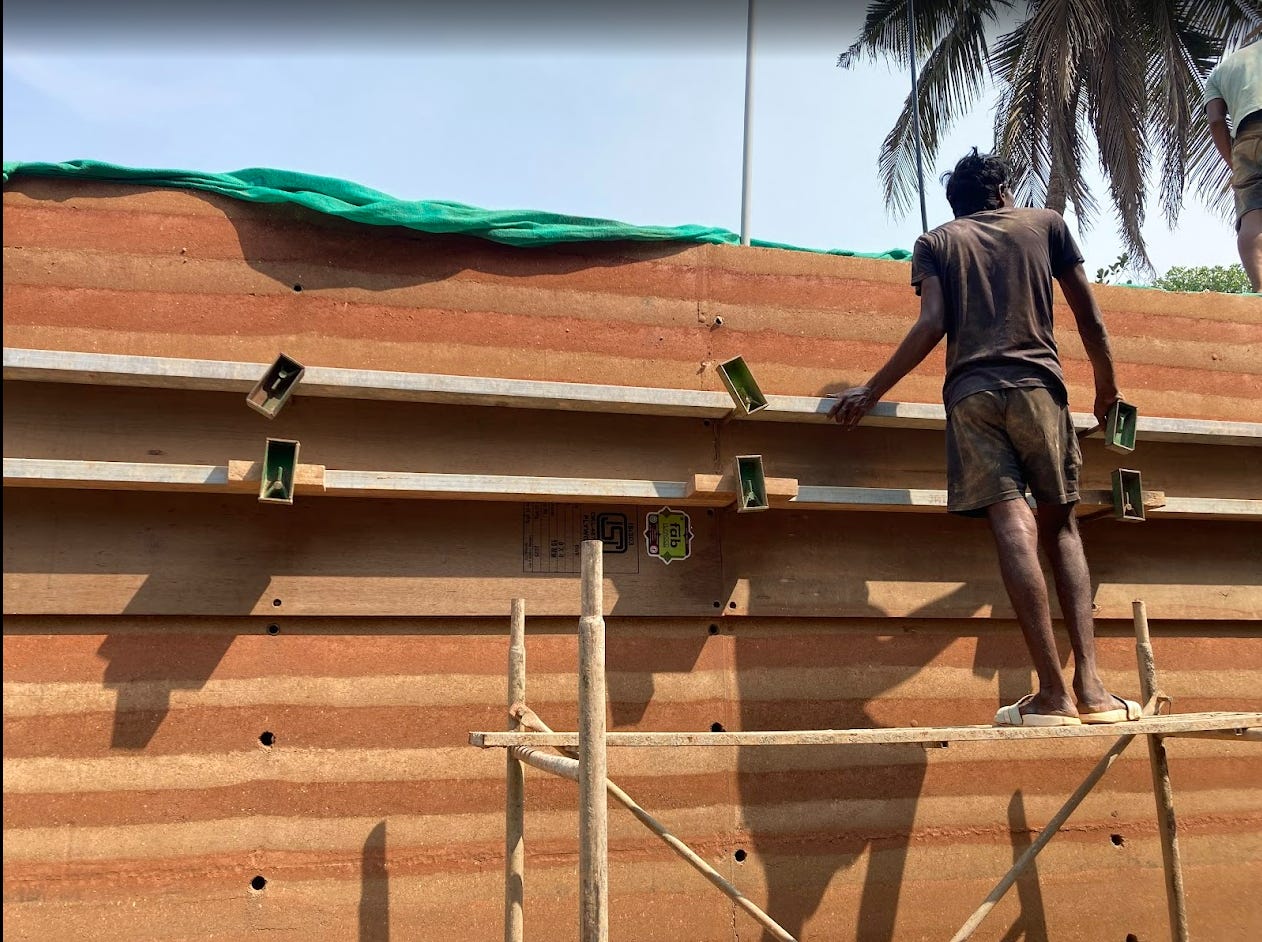
Formwork doesn’t exist as a product. You can’t call a supplier and order rammed earth forms. You can’t rent them. Concrete forms don’t work — wrong dimensions, wrong bracing, wrong tolerances. Every form set must be custom-designed and custom-built for your specific wall layout. That’s weeks of carpentry before ramming begins. The formwork alone might cost more than the soil.
There are some lightweight ready-made formworks available, but I can’t trust them for the tamping force that a low clay, sandy soil would require.
Trained labour doesn’t exist as a pool. Regular masons don’t apply. Masonry is individual units with mortar joints, and rammed earth has no joints, no units, no mortar. Concrete crews are closer but still wrong. Concrete is liquid poured into forms; rammed earth is semi-dry material compacted in layers. Their instincts will mislead them.
Where a trained team is not available, you must train your crew from scratch, on the project’s time and the client’s money. Each person you train might move on after this one job.
Soil isn’t a standard material. Nobody can call a supplier and order “rammed earth mix, tested and ready.” Suppliers sell fill dirt, topsoil, screened soil — none of it tested, none of it guaranteed suitable. Finding usable soil means digging on site or visiting quarries, taking samples, testing each one, finding one that works, negotiating delivery. And “free” soil on-site still needs excavation, sieving, moisture management, and testing before it becomes building material.
The contingency math doesn’t hold. The usual 10–20% contingency assumes predictable variance. Rammed earth variance isn’t predictable. The first batch might fail. Forms might need additional work. Weather stops work for weeks — ten minutes of uncovered rain can push stockpiled soil past usable moisture and cost you a week of drying time.
You need 40–60% contingency minimum —the Indian case— that is my experience.
Design changes are impossible. In conventional construction, you can move a window two feet during the build. In rammed earth, that requires re-engineering the structural load path, potentially demolishing and rebuilding a wall section, timeline delay, added cost. The wall you ram is the final wall. Design must be locked before ramming starts.
This is where the architect’s strength becomes the trap.
Architects design. That’s what clients hire them for—impressive, considered design. With conventional construction, complex design is buildable at reasonable cost because the structural system is flexible. Columns and beams carry the load. Walls are just infill.
With rammed earth, complexity costs exponentially more. Every curve, every unusual opening, every aesthetic flourish adds engineering complexity and construction difficulty. The architect delivers what the client expects— a beautiful design. The client later discovers this design costs three to five times more than a simple rammed earth building.
Simple rammed earth is affordable. Architecturally ambitious rammed earth is expensive. The gap between these two is where budgets break and timelines explode.
The timeline is the other fracture point. The architect estimates based on conventional experience. Three months for walls. Maybe four, to be safe.
Reality: three months of actual work spread across six to nine months of calendar time. Weather delays. Moisture management. Quality verification. Learning curve. Form moving. The crew is learning a process nobody in your town has done before. The walls go up slowly because they must go up slowly. You cannot rush compaction without compromising structure.
The architect tells the client three months. The client plans around three months. Month four arrives with walls half done. Month six arrives with the architect fielding calls they didn’t expect to be fielding. The relationship strains.
None of this is the architect’s fault. The estimating model is wrong for this material. The reference points don’t apply. The supply chain that makes conventional timelines reliable doesn’t exist for rammed earth.
The architect who calls me and asks, “I have a rammed earth project, what should I budget?” — that’s the right call. The architect who budgets first and calls me when it’s already over—that’s the pattern I see too often, including the one I am currently working on.
What works:
Engage someone who has built rammed earth before the estimate is finalized. Not after. Budget 40–60% contingency and explain to the client why. Design simple: good boot, good hat, rational openings, no curves unless the client understands the cost. Lock the design completely before ramming starts. Every outlet, every window, every embedded conduit. Plan for six to nine months of calendar time, not three.
The structural engineer your architect already has is an asset. Use them early. The architect’s material curiosity is an asset. Channel it into designs that work with rammed earth’s nature, not against it.
If the architect’s bid looks comfortable, it’s probably wrong.
If the architect’s bid makes the client uncomfortable, it might be honest.